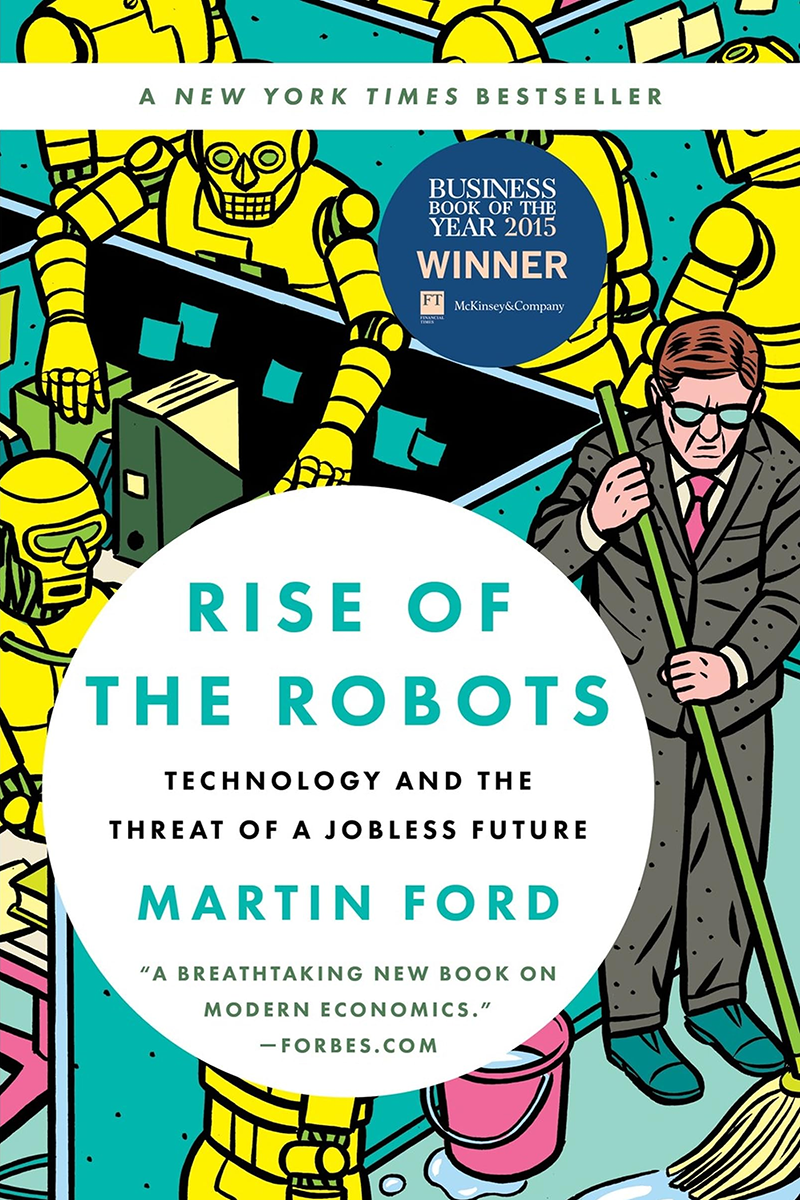
Rise of the Robots: Technology and the Threat of a Jobless Future
Rise of the Robots by Martin Ford examines how automation, robotics, and artificial intelligence are transforming the global economy. The central argument of Rise of the Robots is that technological progress is accelerating faster than society’s ability to adapt, particularly in the labor market.
Ford argues that automation will not only replace traditional manufacturing jobs but will increasingly affect white collar professions and knowledge work as well. Fields such as legal research, journalism, financial analysis, and even aspects of medicine are beginning to experience automation pressure from machine learning systems.
From a systems perspective, Rise of the Robots raises a deeper question about technological progress. When machines become more efficient than humans at performing certain tasks, the economic structures built around human labor begin to shift. The book invites readers to think critically about how technological systems reshape employment, wealth distribution, and social stability.
Rise of the Robots and the Future of Work
One of the central arguments in Rise of the Robots is that the current wave of automation differs from previous industrial revolutions. Earlier technological transformations primarily replaced physical labor. The current wave increasingly targets cognitive work.
Machine learning, data analytics, and advanced robotics now allow machines to perform tasks that once required human judgment. Understanding how machine learning systems operate and why automation is expanding into knowledge work helps explain why Ford believes the labor market could experience unprecedented disruption.
According to Ford, this transformation creates a structural challenge. If machines continue to perform more tasks traditionally carried out by humans, fewer workers may be required to produce the same level of economic output.
This dynamic forms the central warning in Rise of the Robots. The benefits of automation may accumulate primarily to the owners of technology rather than the broader workforce.
Automation, Inequality, and Economic Systems
Another major theme in Rise of the Robots is the potential relationship between automation and economic inequality.
Ford suggests that as automation increases productivity, income may become concentrated among those who control the machines and the intellectual property behind them. If large numbers of workers lose access to stable employment, consumer demand could decline, potentially destabilizing economic systems that depend on widespread participation in the labor market.
This argument places Rise of the Robots within a broader conversation about the future of capitalism. Ford encourages readers to consider whether existing economic structures can adapt to a world where machines increasingly perform productive labor.
From a systems thinking perspective, the book frames automation as a technological shift that interacts with existing economic incentives and institutional structures.
Policy Proposals and Social Responses
Ford does not limit his analysis to technological trends. Rise of the Robots also explores possible policy responses to automation.
One of the most discussed proposals in the book is the concept of universal basic income. Ford suggests that if automation significantly reduces the demand for human labor, societies may need new mechanisms to distribute income and maintain economic stability.
The book also raises broader questions about education, workforce development, and social policy. If automation continues to expand, institutions such as universities, training programs, and labor markets may need to evolve to prepare individuals for a different economic landscape.
These discussions make Rise of the Robots not only a technology book but also a work of economic and social analysis.
View Rise of the Robots on AmazonStrengths of Rise of the Robots
One of the strongest aspects of Rise of the Robots is the depth of research behind Ford’s arguments. The book draws on labor statistics, economic trends, and technological developments to support its claims about the future of work.
Another strength is Ford’s ability to explain complex technological ideas in clear and accessible language. Readers without a background in computer science or economics can still follow the central arguments.
The book is also valuable because it connects technological change to broader social consequences. Instead of focusing only on the capabilities of machines, Ford examines how automation interacts with economic incentives, political institutions, and labor markets.
Limitations of the Book
Despite its strengths, Rise of the Robots has drawn criticism for presenting a somewhat dystopian view of the future.
Some critics argue that Ford may underestimate the ability of labor markets to adapt to technological change. Historically, new technologies have often created new categories of work even as they eliminated older ones.
Another limitation is that some of the policy proposals remain theoretical. While ideas such as universal basic income are discussed, the book does not explore the practical details of implementing these policies on a large scale.
Readers who are interested in detailed policy frameworks may therefore find the discussion somewhat incomplete.
Why Rise of the Robots Still Matters in 2026
Nearly a decade after its publication, Rise of the Robots remains highly relevant. Advances in artificial intelligence, automation, and robotics continue to reshape industries around the world.
The questions raised in the book about employment, inequality, and technological responsibility have only grown more urgent. As automation expands into new areas of the economy, societies will increasingly need to consider how to balance technological progress with economic stability.
Rise of the Robots encourages readers to think about automation not only as a technological phenomenon but also as a structural shift in how modern economies function.
Final Verdict
Rise of the Robots offers a thoughtful and provocative exploration of automation and its potential impact on the future of work.
Martin Ford combines technological insight with economic analysis to highlight the challenges that advanced automation may create for modern societies. While some predictions may appear pessimistic, the book raises important questions about how economic systems should adapt to rapid technological change.
A strong complementary read is Why Machines Learn. While Ananthaswamy’s exploration of the AI revolution focuses on the “what” and “why” behind machine intelligence, Rise of the Robots asks the more pressing question of “so what?” In other words, Ford examines what these technologies can accomplish and, more importantly, the risks they pose to the workforce, labor markets, and broader consumer economy.
For readers interested in artificial intelligence, automation, and the future of labor, Rise of the Robots provides a compelling framework for understanding one of the most significant technological transformations of the modern era.
My Personal Rating
This book always takes me back to my days at Progress Software, when a colleague and I would walk to the nearest Indian restaurant and discuss a wide range of topics. The guy was brilliant and always seemed to be one step ahead of everyone else. He recommended Rise of the Robots to me, and at the time it was difficult to wrap my head around the idea that robots might not only take over certain jobs, but eventually gain the ability to write code and program themselves.
And just a few years later, here we are! This is a book worth having in your library—not only as a guide to the future of automation and artificial intelligence, but also as something to revisit and critique once robots become more fully integrated into society.
View Rise of the Robots on Amazon