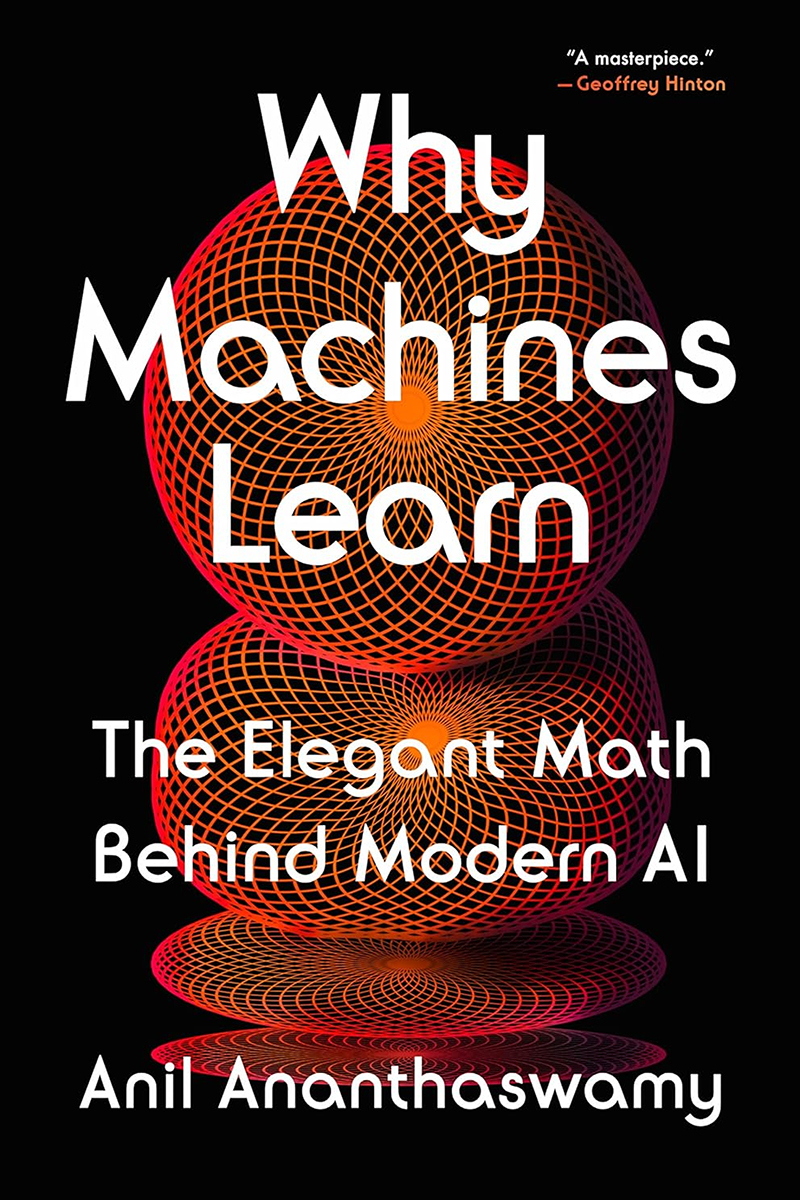
Why Machines Learn (And How Machine Learning Algorithms Work)
Why Machines Learn by Anil Ananthaswamy is an accessible and intellectually satisfying exploration of the mathematics that powers modern artificial intelligence. Rather than focusing on coding tutorials or sensational predictions about AI, the book investigates a deeper question: why machines learn in the first place.
Ananthaswamy approaches the subject as both a science writer and storyteller. He connects the mathematical foundations of machine learning—linear algebra, calculus, probability, and optimization—to the practical systems that shape modern technology. The result is a narrative that helps readers understand how machine learning algorithms work without requiring them to become mathematicians.
What I appreciated most about the book is its effort to demystify artificial intelligence. Instead of portraying AI as mysterious or magical, Ananthaswamy demonstrates that the behavior of learning systems emerges from mathematical principles that have existed for decades. When those principles are applied to large datasets and powerful computing systems, they produce the models that now drive search engines, recommendation systems, and language models.
From a systems or engineering perspective, the book reframes AI as a set of mathematical tools designed to extract patterns from data rather than an opaque technological miracle.
Why Machines Learn: The Mathematics Behind Modern AI
At its core, Why Machines Learn argues that contemporary AI is fundamentally mathematical. Neural networks, recommendation engines, and language models may appear complex, but their behavior ultimately emerges from a handful of mathematical concepts.
The book carefully explains how data can be represented as vectors and matrices, allowing algorithms to perform calculations that identify patterns within massive datasets. Concepts such as eigenvalues, dimensionality reduction, and optimization appear throughout the narrative as the mechanisms that enable machines to learn from experience.
One of the most important ideas discussed is gradient descent, a method used to adjust a model’s parameters so that it gradually improves its predictions. Understanding gradient descent offers a glimpse into how machine learning algorithms work at a fundamental level: models repeatedly adjust themselves in response to errors until they converge on a useful solution.
By breaking down these concepts step by step, Ananthaswamy provides a compelling explanation of why machines learn rather than simply describing what machine learning systems do.
Historical Foundations of Machine Learning
Another strength of the book is its historical framing. The mathematics behind modern AI did not appear suddenly with the rise of deep learning. Instead, it emerged from decades of work by mathematicians, statisticians, and computer scientists.
Ananthaswamy traces this intellectual lineage through early neural network research, advances in statistical learning theory, and the development of optimization methods that eventually enabled modern deep learning systems.
Seeing this progression helps explain why machines learn in a way that feels grounded rather than mystical. Each breakthrough builds on earlier mathematical insights, revealing a long chain of intellectual discovery that ultimately shaped today’s AI landscape.
For readers curious about how machine learning algorithms work, this historical perspective provides useful context. It shows that the algorithms powering today’s AI systems are part of a much larger scientific tradition.
Understanding the Limits of Machine Learning
One of the most refreshing aspects of the book is its honesty about the limitations of machine learning.
Ananthaswamy discusses concepts such as overfitting, the curse of dimensionality, and the challenges of working in high-dimensional spaces. These ideas illustrate that learning systems are powerful but imperfect tools.
Understanding these limitations is essential to understanding why machines learn in the first place. Learning occurs because algorithms search for patterns in data, but those patterns can sometimes reflect noise, bias, or incomplete information.
The book therefore encourages readers to develop a healthy skepticism about AI systems. Learning algorithms are effective when used carefully, but they can produce misleading results when their assumptions are misunderstood.
View Why Machines Learn on AmazonStrengths of Why Machines Learn
The greatest strength of Why Machines Learn lies in its balance between accessibility and intellectual depth. Ananthaswamy manages to explain difficult mathematical concepts without oversimplifying them or overwhelming the reader.
The book also stands out for its storytelling. Rather than presenting mathematics in isolation, Ananthaswamy introduces the scientists and researchers who developed the ideas behind machine learning. These human stories make the technical material far more engaging.
Another notable strength is the book’s emphasis on clarity. By focusing on the mathematical foundations of AI, Ananthaswamy helps readers understand how machine learning algorithms work instead of simply describing their outputs.
This clarity is particularly valuable at a time when AI is often presented as an inscrutable “black box.”
Limitations of the Book
Despite its many strengths, Why Machines Learn may feel mathematically dense for some readers. While the author explains concepts carefully, a basic familiarity with algebra or calculus can make the material easier to follow.
The book also focuses primarily on mathematical explanations rather than broader ethical discussions. Issues such as algorithmic bias, political influence, and social consequences are acknowledged but not explored in depth.
Readers looking for a detailed analysis of AI ethics may therefore need to consult additional sources. Ananthaswamy’s primary objective is to explain how machine learning algorithms work, not to conduct a comprehensive critique of the technology.
Finally, readers who already have a deep technical background in machine learning may find the material introductory. The book is designed more as a conceptual explanation than a technical research text.
Does this Book Still Matter in 2026?
Understanding why machines learn has become increasingly important as artificial intelligence continues to influence everyday life. From recommendation systems and image recognition to large language models, machine learning now powers many of the technologies people interact with daily.
Books like Why Machines Learn play an important role in helping readers move beyond the hype surrounding AI. By explaining how machine learning algorithms work, Ananthaswamy encourages readers to approach artificial intelligence with curiosity, critical thinking, and a stronger understanding of its mathematical foundations.
For engineers, technologists, and analytically minded readers, this perspective is particularly valuable. The book reminds us that even the most advanced AI systems ultimately depend on understandable mathematical principles.
Final Verdict
Why Machines Learn is a thoughtful and accessible introduction to the mathematics that powers modern artificial intelligence. Through clear explanations, historical insight, and engaging storytelling, Ananthaswamy shows that the apparent magic of AI is grounded in elegant mathematical ideas.
By focusing on why machines learn rather than simply describing AI applications, the book helps readers understand the deeper logic behind modern machine learning systems.
It may not satisfy readers looking for advanced mathematical rigor or extensive discussions of AI ethics, but it succeeds brilliantly at explaining how machine learning algorithms work in a way that is both engaging and intellectually rewarding.
For anyone interested in artificial intelligence, mathematics, or the foundations of modern computing, Why Machines Learn offers a valuable and illuminating perspective.
My Personal Rating
While Rise of the Robots focuses on the societal consequences of automation and the disruption it may bring, Why Machines Learn shifts the conversation toward the foundations of the technology itself. By exploring the mathematics that power machine learning systems, the book helps demystify a field that is often treated as mysterious or even magical. Read together, the two books offer complementary perspectives—one examining the potential impact of intelligent machines, and the other explaining the principles that make them possible.
For engineers, technologists, and anyone curious about the logic behind the algorithms shaping modern life, this book definitely belongs in your personal library.
View Why Machines Learn on Amazon