Book Overview
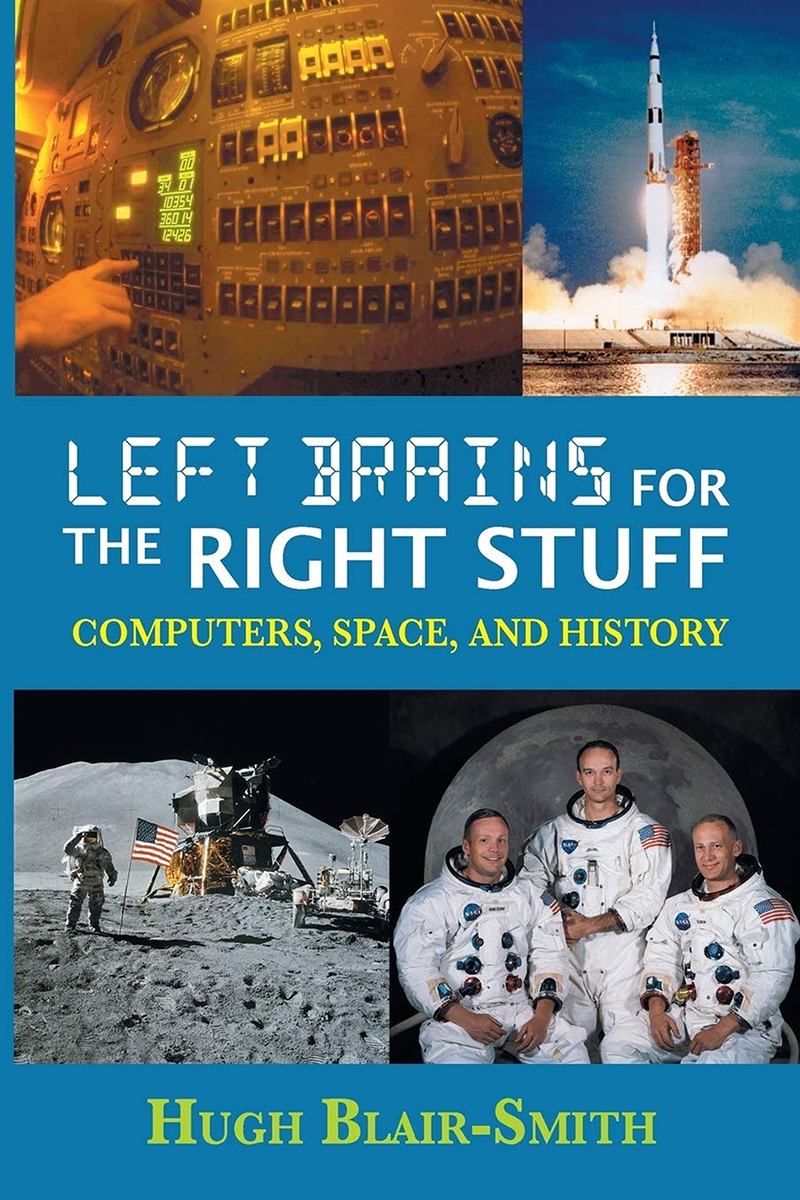
Left Brains for the Right Stuff by Hugh Blair‑Smith offers a rare insider perspective on the engineering effort behind the Apollo program. Part memoir, part technical history, and part geopolitical reflection, the book chronicles Blair-Smith’s work at the MIT Instrumentation Laboratory where he helped develop the software and systems for the Apollo Guidance Computer.
Through his personal experience, Left Brains for the Right Stuff explains how the Apollo program became a convergence point for engineering, computing, and Cold War politics. Blair-Smith situates his story within the broader history of rocketry and space exploration, referencing early pioneers such as Robert H. Goddard and tracing the political urgency created by events like Sputnik launch and the challenge issued by John F. Kennedy to land a human on the Moon.
The result is an unusually detailed narrative about how engineering teams transformed an ambitious national goal into a functioning technological system.
Systems Engineering and the Apollo Program
One of the most important lessons in Left Brains for the Right Stuff is the central role of systems engineering. Blair-Smith emphasizes that the success of the Apollo program did not depend on isolated breakthroughs or individual brilliance. Instead, it required tightly coordinated collaboration across hardware design, software development, and mission operations.
The development of the Apollo Guidance Computer illustrates this principle clearly. The computer had extremely limited memory and processing power compared with modern machines. Engineers were forced to design highly efficient software that could operate reliably in a constrained environment.
Blair-Smith describes how the AGC used a command interface built around the famous VERB-NOUN system, which allowed astronauts to interact with the computer through structured commands. The design demonstrates how thoughtful interface engineering can bridge complex technology and human operators.
From an engineering perspective, Left Brains for the Right Stuff highlights how constraints often drive innovation. Limited hardware resources forced developers to think carefully about software architecture, memory management, and reliability.
Technology, Politics, and the Cold War
Another theme running through Left Brains for the Right Stuff is the relationship between engineering and geopolitics. The Apollo program unfolded during the intense rivalry between the United States and the Soviet Union.
Events such as the launch of Sputnik created political pressure to accelerate technological development. Government oversight, national pride, and Cold War competition all influenced the pace and funding of the space program.
Blair-Smith argues that while these political forces created urgency, they did not dictate the engineering decisions themselves. Engineers still had to solve practical problems related to navigation, computing, and spacecraft reliability.
This tension between political ambition and technical reality forms an important backdrop to the story told in Left Brains for the Right Stuff.
The Human Side of Engineering Innovation
Although the book contains significant technical detail, Left Brains for the Right Stuff also captures the human side of engineering.
Blair-Smith reflects on the teamwork, pressure, and creativity that defined the Apollo program. Engineers were working under extraordinary expectations while confronting difficult technical challenges.
Moments such as the Apollo 1 fire and the crisis during Apollo 13 highlight how fragile complex technological systems can be.
These events remind readers that engineering is not only about technical design. It also involves responsibility, resilience, and constant adaptation under pressure.
View Left Brains for the Right Stuff on AmazonStrengths of Left Brains for the Right Stuff
One of the greatest strengths of Left Brains for the Right Stuff is the authenticity of its perspective. Blair-Smith writes as someone who directly participated in the development of the Apollo Guidance Computer. His firsthand experience gives the narrative a level of detail that is difficult to replicate.
Another strength is the book’s educational value. The explanations of AGC hardware and software provide readers with insight into early computer engineering practices. For readers interested in systems engineering, computing history, or aerospace development, these sections are particularly valuable.
The book also succeeds in connecting technical work with the broader historical context of the Space Race. By linking engineering decisions to Cold War politics and national priorities, Blair-Smith shows how technological innovation often emerges from complex social environments.
Limitations of the Book
Despite its strengths, Left Brains for the Right Stuff can be technically dense in certain sections. The frequent use of acronyms and specialized terminology may require readers to pause and research unfamiliar concepts.
Some chapters also focus heavily on Blair-Smith’s personal experiences at the MIT laboratory. While this perspective provides valuable detail about the Apollo Guidance Computer, it means that other parts of the NASA contractor network receive less attention.
Readers seeking a broader overview of the entire Apollo program may therefore find the narrative somewhat narrow in scope.
Why Left Brains for the Right Stuff Still Matters in 2026
Left Brains for the Right Stuff remains an important contribution to the history of computing and space exploration. The Apollo program represents one of the most ambitious engineering efforts in human history, and the development of its guidance computer played a crucial role in enabling lunar missions.
The book also highlights how early computer engineers solved complex problems with extremely limited hardware resources. Many of the principles described in the book remain relevant to modern systems engineering, including efficiency, reliability, and human-machine interaction.
For readers interested in the intersection of engineering, history, and innovation, Left Brains for the Right Stuff provides valuable insight into the mindset and discipline required to achieve seemingly impossible technological goals.
Final Verdict
Left Brains for the Right Stuff is a thoughtful and technically rich account of the engineering work behind the Apollo program. Hugh Blair-Smith combines memoir, history, and systems engineering to show how teams of engineers transformed bold national ambitions into functional technological systems.
While the technical density may challenge readers without an engineering background, the insights into early computing, spacecraft guidance systems, and collaborative innovation make the effort worthwhile.
My Personal Rating
This book was recommended to me by a colleague, Glen Logan, who also receives a shout-out in the book itself. Left Brains for the Right Stuff was right up my alley, as I’ve always been something of a space geek. My earliest ambition was to become an astronaut, and although the thought of tearing through the ozone now frightens me a bit, I have the utmost respect for the pioneers who did.
For anyone interested in space history, computer engineering, or the technological achievements of the Cold War era, Left Brains for the Right Stuff offers a fascinating and informative perspective.
View Left Brains for the Right Stuff on Amazon