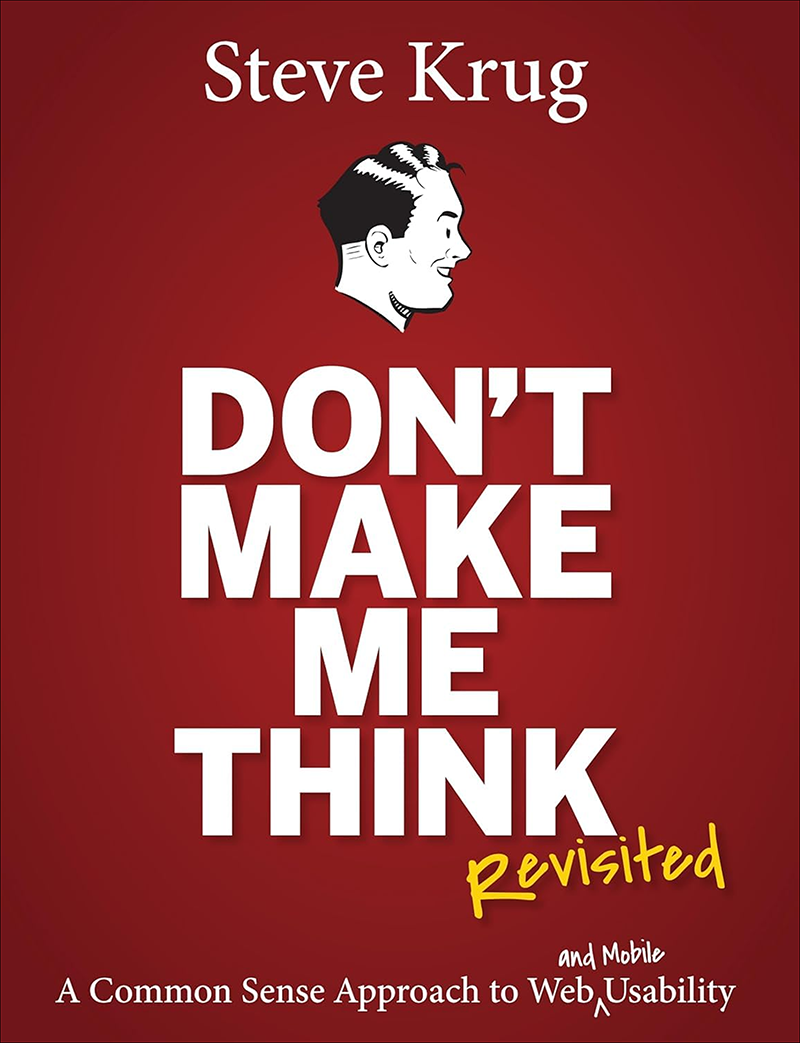
Don’t Make Me Think: A UX Design Classic Explained
Don’t Make Me Think, Revisited by Steve Krug remains one of the most influential books on usability and web design. First published in 2000 and later updated to reflect modern digital environments, the book explains how thoughtful design can reduce friction between users and digital interfaces.
At the center of Don’t Make Me Think is a simple but powerful principle. Good design minimizes the mental effort required for users to accomplish their goals. When websites or applications force users to pause, interpret confusing elements, or search for navigation cues, the design has already failed.
Krug approaches usability with a tone that is practical, humorous, and grounded in real world experience. The revised edition updates the discussion to address modern challenges such as mobile interfaces, responsive design, and accessibility while preserving the straightforward philosophy that made the original book so influential.
The Core Principle Behind Don’t Make Me Think
The defining idea in Don’t Make Me Think is that digital interfaces should be self evident. Users should immediately understand what they can do, where they are, and how to proceed.
Krug explains that most people do not read websites carefully. Instead, they scan pages quickly, choose the first option that appears reasonable, and rely on trial and error when navigation becomes unclear.
Because of these behaviors, effective design must reduce cognitive load. Navigation should be obvious. Content should be organized visually. Clickable elements should look clickable. In short, users should not have to stop and interpret the interface.
This principle is the reason the phrase don’t make me think became a foundational concept in usability design.
Understanding Real User Behavior
Another major lesson in Don’t Make Me Think is the recognition that users behave differently than designers often expect.
Krug identifies three common user behaviors that influence interface design:
- Users scan rather than read
- Users “satisfice” rather than optimize. FYI: Satisfice is a real term in academia. It combine the words “satisfy” and “suffice” to describe the process of choosing the first option that is good enough rather than searching for the best possible option. It was coined by Herbert A. Simon when describing bounded rationality, which explains how people actually make decisions in the real world.
- Users rely on trial and error instead of instructions
These behaviors explain why complicated navigation structures and dense text often fail. Instead of forcing users to interpret complex layouts, designers should use clear visual hierarchy, concise content, and obvious interaction elements.
Krug also emphasizes the importance of editing web content aggressively. Eliminating unnecessary text, marketing language, and filler content makes pages easier to scan and understand.
View Don't Make Me Think, Revisited on AmazonUsability Testing and Practical Design
One of the most valuable sections of Don’t Make Me Think focuses on usability testing.
Krug argues that effective usability testing does not need to be expensive or complicated. Even small, informal tests with a handful of participants can reveal major usability problems.
The goal is not to prove a design is perfect. The goal is to observe how real users interact with the interface and identify points of confusion.
This philosophy encourages teams to conduct frequent, lightweight usability tests throughout the design process. Small adjustments based on real user behavior can dramatically improve the overall experience.
Strengths of Don’t Make Me Think
The greatest strength of Don’t Make Me Think is its clarity. Krug explains usability concepts in straightforward language supported by simple examples, diagrams, and humor.
Another strength is the book’s practical orientation. Rather than focusing on abstract design theory, Krug emphasizes real world usability principles that designers, developers, and product teams can apply immediately.
The book also provides valuable insight into user psychology. By understanding how people actually interact with digital interfaces, designers can create experiences that respect the user’s time and attention.
These insights make Don’t Make Me Think accessible to a wide audience, including designers, developers, product managers, and entrepreneurs.
Limitations of the Book
While Don’t Make Me Think is widely respected, some readers in the UX field may find its concepts familiar. Many of the usability principles discussed in the book have become standard practices in modern design.
Certain examples and illustrations also reflect earlier web design trends. Highly interactive applications, artificial intelligence interfaces, and complex enterprise systems introduce challenges that extend beyond the scope of the book.
Additionally, Krug focuses primarily on practical experience rather than academic research. Readers looking for rigorous empirical studies or advanced UX frameworks may need additional sources.
Why Don’t Make Me Think Still Matters in 2026
Despite these limitations, the central idea behind Don’t Make Me Think remains highly relevant. As digital systems become more complex, the need for clear and intuitive interfaces becomes even more important.
The book reminds designers and developers that usability is not only about aesthetics. It is about reducing friction, simplifying interactions, and respecting the user’s cognitive effort.
In many ways, Krug’s philosophy aligns with broader principles in engineering and systems design. Well designed systems remove unnecessary complexity and allow users to focus on their goals.
Final Verdict
Don’t Make Me Think, Revisited continues to serve as one of the most practical introductions to usability and interface design.
Steve Krug distills decades of design experience into simple principles that remain applicable across websites, mobile apps, and digital products. The book’s emphasis on clarity, visual hierarchy, and frequent usability testing offers a valuable framework for creating intuitive digital experiences.
My Personal Rating
I read the original book years ago and found it both insightful and humorous. UI and UX development remain close to my heart, which is probably evident in nearly every project I take on. Art and design were my first creative interests, so I’m always looking for ways to make the things I build visually appealing and intuitive for the people who use them.
Although the book doesn’t dive deeply into advanced UX research or emerging technologies, its core message remains timeless. Interfaces should be obvious, efficient, and easy to navigate.
For anyone involved in web design, product development, or user experience, Don’t Make Me Think, Revisited serves as a clear and enduring reminder of what good design is meant to accomplish.
View Don't Make Me Think, Revisited on Amazon