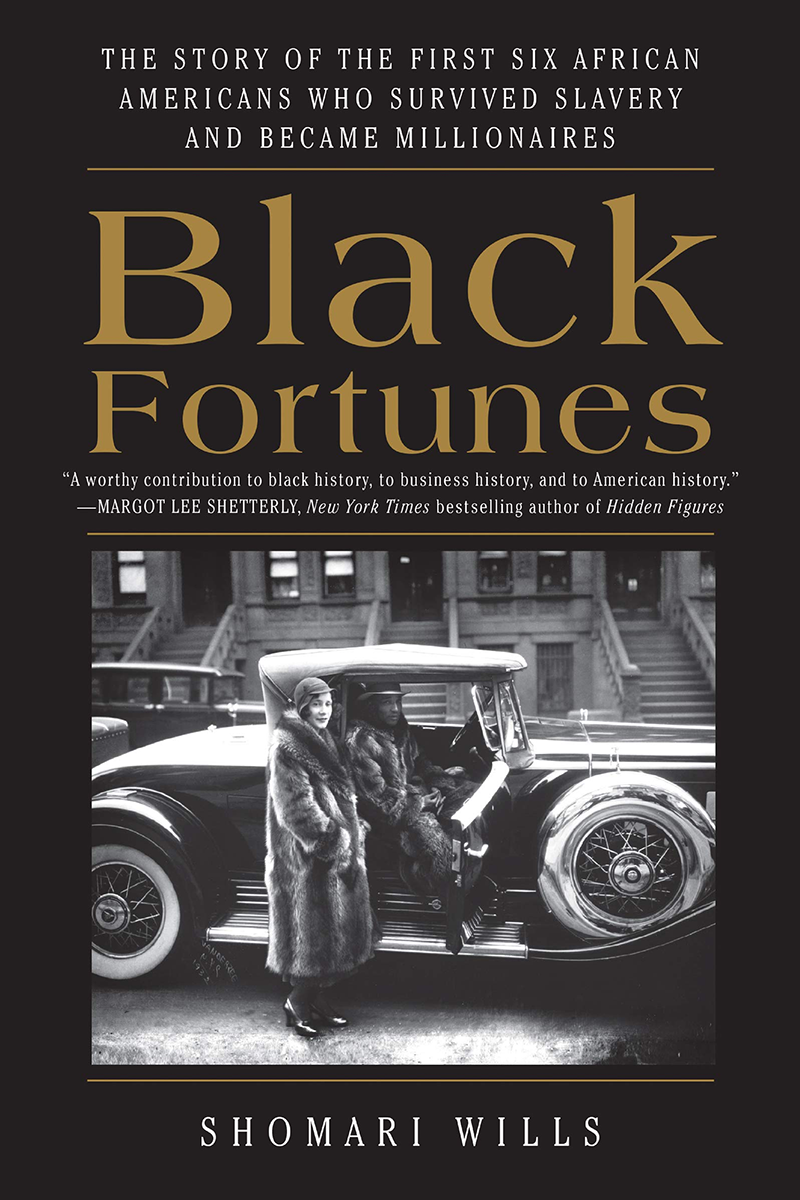
Black Fortunes: The Systems Behind 19th Century Black Wealth
Black Fortunes tells the stories of six Black entrepreneurs who became some of the earliest Black millionaires in American history. Written by historian Shomari Wills, the book spans roughly a century, from the early nineteenth century through the 1920s. Through a series of interconnected biographies, Wills introduces readers to Mary Ellen Pleasant, Robert Reed Church, Hannah Elias, Annie Turnbo Malone, Madam C.J. Walker, and O.W. Gurley.
Each of these figures accumulated wealth during a period when the legal and economic systems of the United States were openly hostile to Black prosperity. This was not simply a time of inequality. It was a period defined by racial violence, legal exclusion, and deliberate barriers to economic mobility.
What makes the book particularly compelling is that Wills does not treat these individuals as isolated success stories. Instead, he situates their achievements within the larger structure of American capitalism. Their wealth was built through strategy, risk taking, innovation, and community investment, but it was also constantly threatened by the systems surrounding them.
Reading this as both a technologist and an entrepreneur, the book feels less like a collection of biographies and more like a case study in resilience within constrained systems.
Entrepreneurship Under Structural Constraints
One of the most striking themes in Black Fortunes is the emergence of Black enterprise long before the Civil Rights era. These entrepreneurs built wealth in environments where legal protections were inconsistent and economic sabotage was common.
Mary Ellen Pleasant, for example, developed a reputation as a formidable investor during the California Gold Rush. While quietly supporting the abolition movement, she leveraged real estate and business partnerships to accumulate significant wealth and influence.
Robert Reed Church rebuilt large sections of Memphis through strategic real estate investment, transforming land ownership into a platform for economic empowerment within the Black community.
Annie Turnbo Malone and her student Madam C.J. Walker developed highly successful beauty businesses, creating manufacturing, distribution, and training networks that supported thousands of Black women across the country. Their companies were not simply commercial ventures. They were early examples of scalable entrepreneurship within underserved markets.
O.W. Gurley’s story may be the most widely recognized today. As a developer of Tulsa’s Greenwood District, often referred to as Black Wall Street, he helped build one of the most prosperous Black business communities in American history before it was destroyed in the 1921 Tulsa Race Massacre.
From a systems perspective, what stands out is how these entrepreneurs identified opportunity inside environments that were actively designed to suppress them.
Systems Thinking and the Fragility of Wealth
One of the most sobering lessons in Black Fortunes is the fragility of wealth when institutions fail.
Several of the fortunes described in the book did not survive beyond the lives of their founders. Legal disputes, racial violence, predatory practices, and discriminatory policies frequently dismantled what these individuals had built.
For someone who approaches economic history through a systems lens, this raises an important point. Wealth is not just about accumulation. It is about protection, governance, and transfer across generations.
Without legal protections, financial infrastructure, or stable institutions, even extraordinary entrepreneurial success can become vulnerable.
In modern terms, we might describe this as a failure of systemic resilience. When systems are unstable, individual success does not always translate into generational wealth.
View Black Fortunes AmazonCommunity Investment and Civic Responsibility
Another theme running through the book is the relationship between personal ambition and community responsibility.
Many of these entrepreneurs reinvested heavily in the communities around them.
Madam C.J. Walker funded educational initiatives and supported civil rights causes. Robert Reed Church used his influence to help establish institutions that strengthened Black civic life. Mary Ellen Pleasant supported abolitionist causes and political organizing.
Their success was not purely individualistic. It was often tied to a broader vision of economic empowerment.
From an entrepreneurial standpoint, this reflects an important principle. Sustainable economic systems rarely emerge from isolated actors. They grow through networks, institutions, and community investment.
Strengths of Black Fortunes
The greatest strength of Black Fortunes is its recovery of overlooked history. The individuals Wills profiles are rarely emphasized in traditional narratives of American economic development, yet their stories reveal a far more complex picture of early Black entrepreneurship.
Wills draws heavily from primary sources, including letters, legal documents, newspapers, and archival records. This research adds credibility and depth to each biography.
Another strength is the book’s accessibility. While grounded in historical scholarship, the writing remains engaging and readable. Wills avoids romanticizing his subjects, portraying them instead as complex individuals navigating extraordinary circumstances.
The result is a work that is both educational and deeply human.
Where the Book Falls Short
Despite its many strengths, the structure of the book occasionally feels uneven.
Because the narrative moves between six extensive biographies, the pacing can sometimes feel abrupt. Readers may find themselves adjusting to new story lines before fully processing the previous one.
Another limitation is that the book occasionally hints at larger structural failures without fully unpacking them. The destruction of wealth through violence, legal manipulation, or economic marginalization is discussed, but a deeper systemic analysis could have strengthened the historical argument.
These issues do not undermine the book’s value, but they do leave room for further exploration.
Why Black Fortunes Still Matters in 2026
The historical accounts in Black Fortunes remain highly relevant today.
Modern discussions around economic inequality, generational wealth gaps, and entrepreneurship often begin in the twentieth century. Wills demonstrates that Black wealth creation has a much longer and more complex history.
These stories highlight both the ingenuity of early Black entrepreneurs and the structural barriers that repeatedly disrupted their success.
For readers interested in entrepreneurship, economic systems, or American history, the book provides a valuable reminder that wealth building has always been shaped by the institutions surrounding it.
Final Verdict
Black Fortunes is both a historical account and a study in resilience. Through the stories of six pioneering entrepreneurs, Shomari Wills reveals a largely overlooked chapter of American economic history.
The book challenges simplified narratives about Black entrepreneurship while illustrating how innovation, risk taking, and strategic thinking allowed individuals to build wealth in deeply hostile environments.
For readers approaching the subject from an entrepreneurial or systems perspective, the lessons are clear. Success is not only about identifying opportunity. It is also about understanding the structures that enable or constrain that opportunity.
My Personal Rating
Despite minor structural flaws, Black Fortunes is a powerful and necessary work. It expands our understanding of American capitalism and reminds us that the history of entrepreneurship in this country is far more diverse and complex than many narratives suggest.
Add this one to your library.
View Black Fortunes Amazon