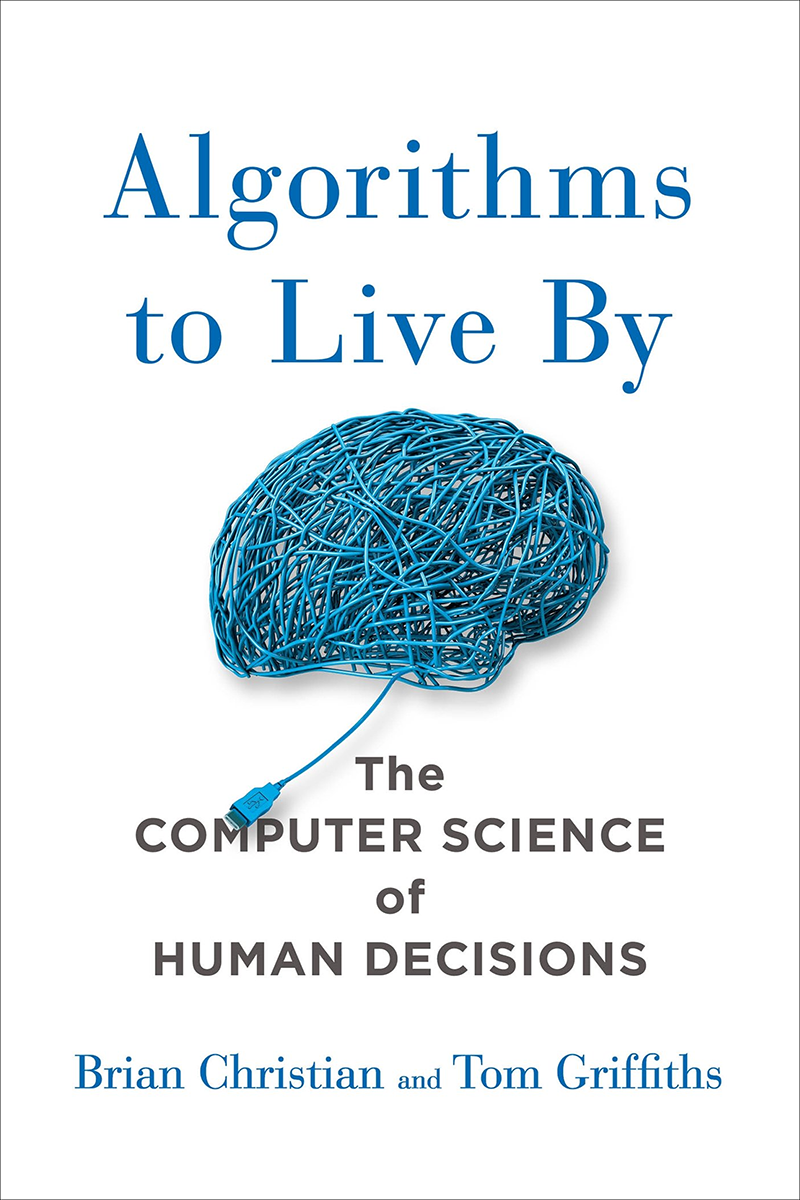
Algorithms to Live By: Computer Science for Everyday Decisions
Algorithms to Live By explores a fascinating premise: many everyday decisions can be improved by applying ideas from computer science. Written by Brian Christian and Tom Griffiths, the book examines how computational strategies used in software systems can help humans make better decisions under uncertainty.
The authors take familiar algorithmic concepts—optimal stopping, scheduling, caching, and probabilistic reasoning—and apply them to everyday situations such as apartment hunting, managing email, organizing work, or deciding when to stop searching for a better option.
What makes Algorithms to Live By particularly compelling is that it reframes algorithms as practical decision frameworks rather than abstract mathematical tools. From a systems or engineering perspective, the book essentially argues that life is full of optimization problems, and algorithmic thinking provides structured ways to solve them.
In that sense, the philosophy behind algorithms to live by resembles the mindset many engineers already apply to complex systems: reduce uncertainty, identify constraints, and use repeatable decision strategies instead of guesswork.
The Core Idea Behind Algorithms to Live By
At its heart, Algorithms to Live By proposes that everyday life contains the same kinds of tradeoffs that appear in computing systems. Resources are limited, time is finite, and decisions must often be made without perfect information.
Algorithms provide structured solutions to these problems.
The book demonstrates that computational thinking can turn ambiguous life decisions into structured decision models. Instead of relying entirely on intuition, individuals can adopt strategies that balance exploration, efficiency, and risk.
This approach mirrors how software engineers design systems. When faced with uncertainty, engineers rely on tested strategies rather than improvisation. The philosophy behind Algorithms to Live By suggests that similar approaches can improve decision making in daily life.
The 37 Percent Rule and Optimal Stopping
One of the most memorable ideas in the book is the optimal stopping rule, often referred to as the 37 percent rule.
The principle is simple: when searching through a sequence of options, spend roughly the first 37 percent of the search time exploring possibilities without committing. After that point, select the next option that is better than everything seen so far.
This rule highlights a common decision-making challenge: balancing patience with action. In real life, this applies to situations such as job hunting, apartment searching, hiring employees, or even choosing long-term partners.
From an engineering perspective, the optimal stopping rule illustrates a classic optimization problem. Too much exploration wastes time, while acting too early risks missing better options. Algorithms provide a rational balance between these extremes.
The Explore–Exploit Tradeoff
Another central concept in Algorithms to Live By is the explore–exploit dilemma, often illustrated through the “multi-armed bandit” problem.
In computing, this problem describes the tension between trying new strategies (exploration) and repeating strategies that already work (exploitation). The same tradeoff appears constantly in everyday life.
Should you try a new restaurant or return to one you already enjoy?
Should you experiment with a new career path or deepen the one you have?
The book shows that optimal decision making often involves structured exploration early on, followed by focused exploitation once enough information has been gathered.
For entrepreneurs, engineers, and researchers, this principle is particularly relevant. Innovation requires exploration, but progress eventually depends on committing to the best-performing strategy.
View Algorithms to Live By on AmazonAlgorithms for Organization, Memory, and Productivity
The book also examines how algorithmic ideas can improve organization and productivity.
Sorting algorithms, for example, illustrate that perfect organization is not always efficient. Instead, the best organizational strategy depends on how frequently items are used. Frequently accessed items should be easier to retrieve, even if the overall system appears slightly messy.
Caching algorithms provide another example. In computing, caching stores frequently accessed information in locations that are faster to retrieve. Humans naturally follow similar strategies when placing commonly used tools, files, or notes in convenient locations.
The lesson is that productivity is not always about perfection. It is about reducing friction within the system.
Strengths of Algorithms to Live By
One of the greatest strengths of Algorithms to Live By is its accessibility. Christian and Griffiths translate complex computer science concepts into relatable scenarios without overwhelming readers with technical mathematics.
The authors successfully demonstrate how algorithmic thinking can apply to real-world problems such as time management, decision making, and productivity. Each concept is grounded in everyday examples, making abstract computational ideas easier to understand.
Another strength is the book’s interdisciplinary perspective. The authors blend computer science with psychology, behavioral economics, and cognitive science, showing how decision theory connects with human behavior.
This approach reinforces a powerful idea: algorithms are not just tools for machines. They are frameworks for navigating uncertainty.
Limitations of the Book
Despite its strengths, Algorithms to Live By occasionally sacrifices technical depth in favor of accessibility.
Readers with a strong background in computer science may find the explanations simplified. The mathematical rigor behind some algorithms is largely omitted in order to keep the narrative approachable.
The book also touches only briefly on the ethical implications of algorithmic thinking. In modern discussions about artificial intelligence and algorithmic bias, the social impact of algorithms has become an important topic. A deeper exploration of these issues could have strengthened the book’s broader relevance.
Why Algorithms to Live By Still Matters
The ideas presented in Algorithms to Live By are increasingly relevant in a world shaped by data, automation, and artificial intelligence.
Understanding how algorithms manage uncertainty, optimize decisions, and allocate resources can help individuals think more clearly about complex choices. The same strategies used to design efficient computer systems can also guide personal decisions.
For engineers, entrepreneurs, and analytically minded readers, the book offers a reminder that many of life’s challenges resemble optimization problems.
Final Verdict
Algorithms to Live By offers an engaging and thought-provoking introduction to algorithmic thinking outside of traditional computing contexts.
Christian and Griffiths demonstrate that many everyday decisions, whether managing time, choosing opportunities, or organizing information, can benefit from structured decision strategies drawn from computer science.
By applying the principles behind this book, readers can begin to view uncertainty not as chaos but as a problem that can be approached with logic, structure, and thoughtful experimentation.
My Personal Rating
While this book does not attempt to provide deep mathematical instruction, it succeeds in translating powerful ideas from computer science into practical insights for everyday life.
For anyone interested in technology, decision making, and human behavior, Algorithms to Live By is both an accessible and intellectually stimulating read.
View Algorithms to Live By on Amazon