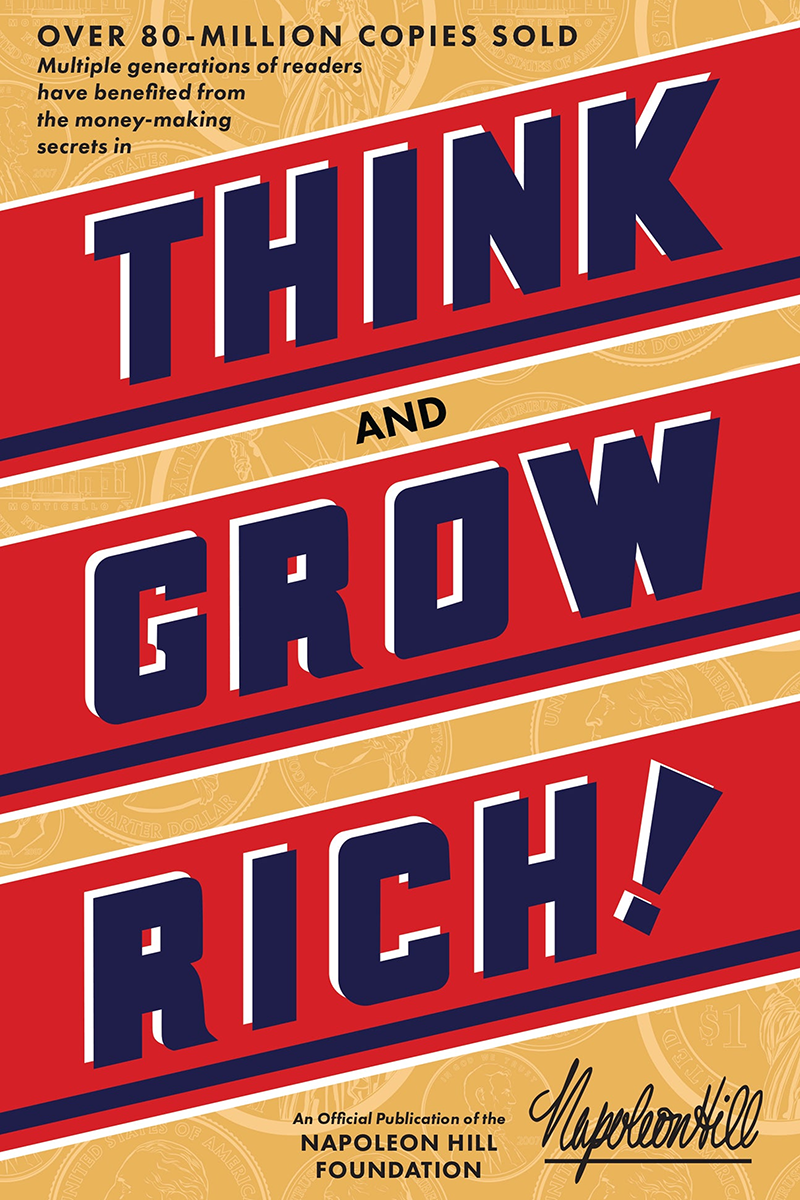
Think and Grow Rich Mindset: An Architecture for Success
First published in 1937, Think and Grow Rich by Napoleon Hill remains one of the most widely read books in the personal development and entrepreneurship space. Hill claimed that the ideas in the book were developed after more than twenty years studying successful industrialists and business leaders, including figures such as Andrew Carnegie, Henry Ford, and Thomas Edison.
At its core, the book is less about financial tactics and more about what might be called a mental architecture for achievement. The central claim behind the think and grow rich mindset is that success is not primarily the result of luck, talent, or circumstance. Instead, Hill argues that it begins with a disciplined way of thinking combined with clear goals and consistent action.
From a systems or engineering perspective, this idea can be interpreted as a behavioral framework. Hill is effectively proposing that if you configure the internal variables correctly—beliefs, habits, persistence, and collaboration—the outputs of the system improve over time.
The Core Framework Behind the Think and Grow Rich Mindset
Hill organizes the book around what he calls the 13 Steps to Riches, a sequence of principles intended to guide individuals toward achievement. These steps include desire, faith, autosuggestion, specialized knowledge, imagination, organized planning, decision, persistence, and the Master Mind principle.
Rather than presenting a technical business strategy, Hill presents a structured way of thinking about goals. The think and grow rich mindset begins with desire, which Hill describes as the starting point of all achievement. Without a clearly defined goal, energy and effort become scattered.
He then introduces autosuggestion, a term he uses to describe the repeated reinforcement of goals and intentions. Although the terminology feels dated, the idea resembles modern discussions about cognitive conditioning and habit formation. Repetition shapes belief, and belief influences action.
Hill also emphasizes the interaction between imagination and specialized knowledge. Creativity without practical skill rarely produces tangible results, while skill without imagination often leads to stagnation. The most productive outcomes occur when the two are combined.
The Master Mind Principle and Collaborative Intelligence
One of the most enduring ideas in the book is what Hill calls the Master Mind principle. This concept describes a group of individuals who share ideas, challenge each other’s assumptions, and collaborate toward shared goals.
From an engineering perspective, the Master Mind principle resembles a distributed system. Complex problems are rarely solved by isolated individuals. Instead, they are solved by networks of people whose combined knowledge produces better outcomes than any single person could achieve alone.
In modern terms, this principle appears in startup teams, engineering organizations, research labs, and entrepreneurial networks. The think and grow rich mindset recognizes that collective intelligence often accelerates progress.
Interpreting the Think and Grow Rich Mindset Through Systems Thinking
When viewed through a technical lens, Hill’s philosophy can be understood as a feedback system for personal development.
Key components of the system include:
- clearly defined goals
- repeated mental reinforcement
- skill development
- disciplined planning
- persistence in execution
- collaboration with capable peers
When these elements interact consistently, they form a loop in which effort produces progress, progress reinforces belief, and belief sustains effort.
Hill does not use engineering terminology, but the structure of his argument resembles a system with inputs, processes, and outputs. The think and grow rich mindset is essentially an attempt to optimize the internal variables that influence long-term success.
View Think and Grow Rich on AmazonStrengths of Think and Grow Rich
The primary strength of Think and Grow Rich lies in its emphasis on mental discipline. Hill strips away the illusion that success is purely accidental and instead frames achievement as the result of deliberate intention and sustained effort.
His insistence on clearly defined goals remains practical even today. Writing down objectives, committing to persistence, and cultivating belief in one’s direction are habits that still appear in modern research on productivity and performance psychology.
Another notable strength is the Master Mind principle. Hill recognized early that collaborative thinking often accelerates progress. In today’s world of entrepreneurial ecosystems, engineering teams, and startup networks, this insight feels remarkably modern.
Finally, the book’s motivational tone has helped it resonate with readers for nearly a century. Hill writes with an urgency that encourages readers to take responsibility for their decisions and actions.
Limitations and Criticisms
Despite its influence, Think and Grow Rich is not without weaknesses.
Some sections rely heavily on metaphysical language that may feel outdated to modern readers who prefer analytical frameworks and empirical evidence. Hill occasionally describes success in ways that sound more philosophical than practical.
The book also depends heavily on anecdotes. While stories can inspire readers, they do not always provide systematic proof.
Another limitation is the lack of concrete financial or business strategies. The think and grow rich mindset focuses on psychology rather than implementation. Readers looking for specific investment strategies, startup frameworks, or business models will need additional resources.
Is the Think and Grow Rich Mindset Still Relevant in 2026?
Despite being written nearly a century ago, the think and grow rich mindset continues to influence discussions about achievement, entrepreneurship, and personal development.
The language may feel dated, but the underlying principles—goal clarity, persistence, belief, and strategic collaboration—still appear in modern discussions about leadership and innovation.
For engineers and entrepreneurs in particular, the book can be interpreted as a framework for thinking about long-term goals rather than a literal formula for wealth.
Final Verdict
Think and Grow Rich endures because it attempts to answer a simple but important question: what internal conditions make success more likely?
Hill’s answer centers on mindset, discipline, and persistence. While the book does not provide detailed financial or entrepreneurial instruction, it offers a psychological framework that can support long-term achievement.
Viewed through a systems lens, the think and grow rich mindset becomes less about mystical thinking and more about configuring the habits, beliefs, and collaborations that shape outcomes.
Used alongside modern knowledge about entrepreneurship, technology, and finance, the book remains a valuable starting point for thinking about ambition, discipline, and personal responsibility.
My Personal Rating
As a lover of history, I particularly enjoyed the narratives Napoleon Hill shares that provide insight into the minds of Thomas Edison, Andrew Carnegie, and other influential figures of that era. It’s fascinating to consider that although many years have passed, the wit, discipline, and perseverance required for success have remained largely unchanged. Mindset has much to do with how we fare in life. As Theodore Roosevelt once said, “Believe you can and you’re halfway there.”
I own most of Napoleon Hill’s work, including his Master Key television series, but Think and Grow Rich remains my favorite. Software engineers and other technical professionals will likely gravitate toward his Master Mind principle, which emphasizes productivity through collaboration and the power of collective thinking.
View Think and Grow Rich on Amazon